Length, width, toe-box shape, per-last calibration.
Length is the easy part and the part everyone does. We measure width from the scan and take instep height from a couple of questions, because a foot that's 26cm long and high-volume needs a different shoe from one that's 26cm and flat.
Two styles from the same brand on different lasts fit differently, and shoppers know it. We calibrate each style against that style's own return data, so a recommendation reflects the shoe in front of them.
A tool that can only say 'size up' is guessing. Half sizes and D/E/EE widths are where footwear fit is actually decided, and they're first-class in the recommendation, not a footnote.
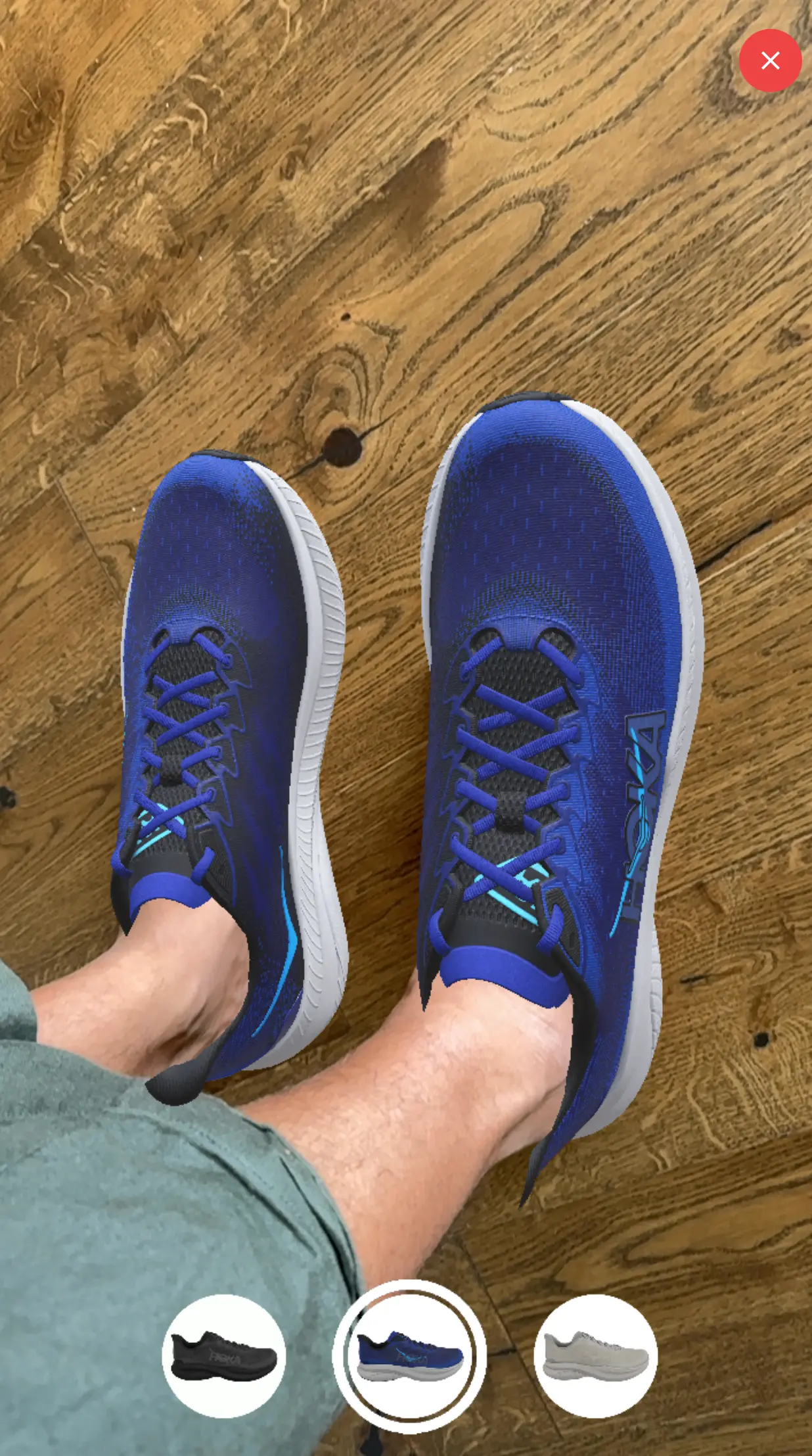
Not a photo spin. A true-to-life model the shopper can rotate, inspect from the sole up, recolour, and then place on their own feet through the camera.
Ice skates. Safety boots. Barefoot. Trail.
If it goes on a foot, we’ve sized it.
The footwear numbers, with the brands attached.
Every figure below came from a named customer’s own store. If we can’t name the brand, we don’t publish the number.
Proven in a four-month A/B test against a control across EMEA.
Read the case studyFour products, one shopper graph.
Foot scan, per-last calibration, half sizes and widths.
See how it worksTrue 3D models and live camera try-on, in the browser.
See how it worksPhotorealistic try-on from a single shopper photo.
See how it worksConversational discovery grounded in your catalogue.
See how it worksFootwear fit, answered
Why do footwear brands need a different sizing tool from apparel brands?
Because a shoe is a rigid shape around a load-bearing part of the body. A knit stretches and a dress a centimetre off still hangs right, but four millimetres in a shoe is the difference between all day and never again. Sizing tools built for garments and stretched to fit footwear miss width, instep height and per-last variation, which is where footwear fit is actually decided.
How accurate is AI shoe sizing?
Accurate enough to move return rates on real traffic. HOKA measured a 6.0% reduction in return rate across EMEA in a four-month A/B test against a control. Pikolinos measured 5.7% in Spain and Birchbury 17.4% in the US.
Does it handle specialist footwear?
Yes. Ice skates with Riedell, occupational and safety footwear with WearerTech, barefoot with Peluva, Birchbury and OzBarefoot, plus performance running, leather lifestyle and winter sports. Specialist categories are where generic sizing fails hardest and where per-last calibration matters most.
Do shoppers have to scan their feet?
No. The scan is one route, not a requirement. A shopper can tell us their usual size, or what size they take in another brand, answer a couple of questions about width and fit preference, and get a recommendation from that. If they do want to scan, it takes about 30 seconds with a phone camera and gives the most precise answer. And a shopper who has already been sized on any StrutFit store arrives at yours already sized, with 2.5 million shoppers served across 100+ countries so far.
Can shoppers see the shoe in 3D and AR?
Yes. We build a true-to-life 3D model of each shoe. Shoppers rotate it, switch colourway, and step into live camera AR to see it on their own feet, all in the browser with no app.
How long does it take to go live?
Two weeks end to end, including the calibration pass against your own return data. The technical install is a Shopify app embed or one script tag.